U of R BFA graduating class’s final production premieres at the Globe Theatre
The digital space has been a part of our day-to-day lives since childhood for a lot of us. Theatre 26, who are the 2026 graduating cohort of U of R’s bachelors in fine arts (BFA) program, can certainly vouch for the impact that technology has had on the way they interact with the digital space.
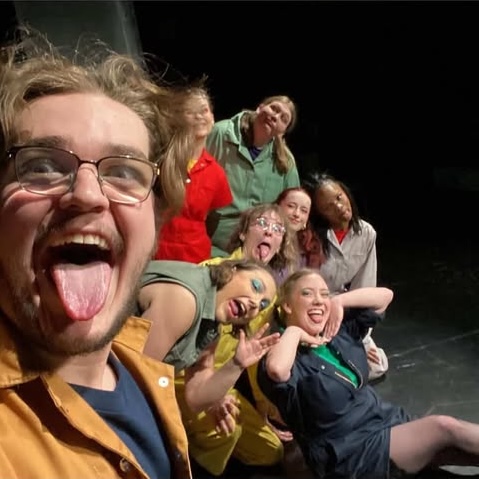
The cohort’s senior production, What Was, What Will, created as part of its devised theatre program, opened at the Globe Theatre on Mar. 11 and closed on Mar. 21. Written and created by the nine graduating students and directed by Judy Wensel, this production was a feast for all the senses as it took the audience through the evolution of nine lives alongside technology. Annika Danielson, Hope Van Vliet, and Sydney Gayle tell the Carillon about their journey of building the show.
Drawing from within
The group began to build the show two years ago. The brainstorming period started with writing personal anecdotes based on prompts and news stories. Van Vliet said that it eventually became impossible to separate themselves from their responses, which resulted in the cast playing versions of themselves. The show revolved around their memories of experiencing the transition from analog to digital technology.
For Gayle, longing for home is a core experience of entering her 20s, which naturally became a part of Sydney’s story.
“I was originally born in Jamaica, then I migrated here in 2010. I’ve mentioned it to my cohort multiple times and we’re finally getting to explore that in this artwork that we’ve created as a collective,” said Gayle. “We see [my character] go on this journey of recalling moments from her past and the struggles of being away from a place which she feels so connected to, and trying to find that connection here.”
Clips of Gayle’s younger self addressing a fictitious audience through the camera lens while pop music played in the background, was featured in the show which many viewers found relatable.
One of the scenes Van Vliet was a part of discussed online dating. Though it’s not a major part of her personality, she said, it was interesting to exaggerate on stage as the character, Hope.
“It was a moment of frustration in our writing process. It was something that I couldn’t tie up in a pretty little bow and say this is a one page story of everything there is to do about online dating,” she said. “So, I decided to explore that and get to know myself a little bit better.”
Danielson shared that her character, Annika, is a symbol of the good of social media. “She draws a lot on nostalgia and childhood memories to make sense of her current day experiences with online dating, communication, [and] social media,” said Danielson.
Some scenes involved Danielson showing her social media posts that acquired thousands of views and likes, and she even went on to show the top results found from searching her name in Google. With the benefits of social media, the audience also got to see Annika’s realization of the negative effects of growing up in a digital age.
We grew up in what I like to call the wild west of technology, so our parents didn’t know how to supervise us. [It] naturally bled into our set.” – Hope Van Vliet
Digital world brought to stage
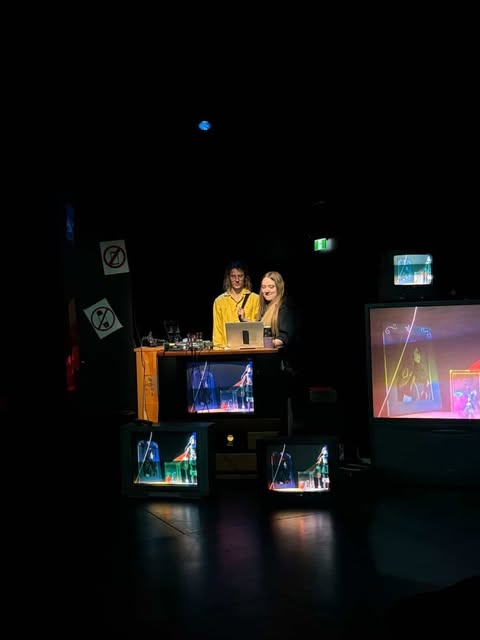
Van Vliet confessed that she had spent about 20 hours a week putting together the intricate technical designs in the show, especially the soundscapes.
“Anything you hear, I did. I am the one who’s most experienced with QLab, so I had to be involved in that process,” said Van Vliet.
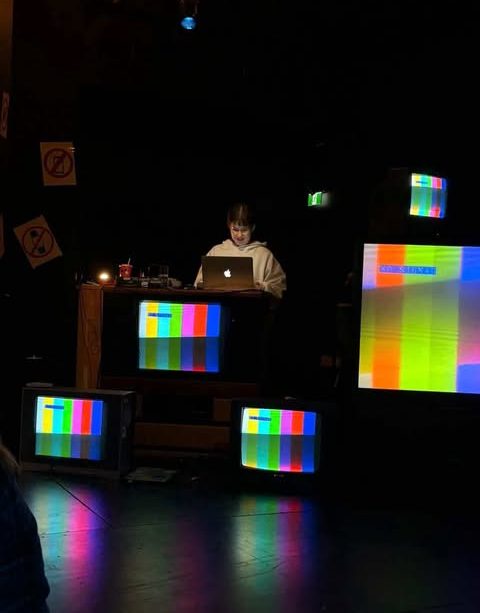
The set consisted of CRT TVs and was used throughout the show. Once the show started, the audience was greeted by home videos of the cast stitched together with old commercials and clips from the past.
“[The show] is all about technology. We’re sort of that middle ground between analog and digital,” said Van Vliet. “We grew up in what I like to call the wild west of technology, so our parents didn’t know how to supervise us. [It] naturally bled into our set.”
Starting conversations
Each member of the cast had to be vulnerable on stage. Confessions of self doubt, how influencers propel young men into the manosphere, troubles in dating, and worries of the future with Artificial Intelligence (AI) were out under the spotlight. Danielson said that the possibility of the AI data centre being built near the city came up in conversations when they were writing the show.
“We just dug deeper into the environmental impacts of AI, how that made us feel, [and] how it was different growing up without AI,” she said.
Van Vliet said that they did not use AI in their production of the show and their equipment and methods were old fashioned. She anticipates that the show might start conversations about AI amongst the viewers.
“AI is becoming such a major part of our daily lives. Just as artists, it’s so hard to see AI taking over and to be okay with that,” she said. “The technology we used in the show […] it’s all analog and that’s very intentional. It’s demonstrating what can be done without AI.”
We just dug deeper into the environmental impacts of AI, how that made us feel, [and] how it was different growing up without AI.” – Annika Danielson
What they hope to leave behind
Gayle says that though all generations can resonate with the show, those who can relate most are Gen Zs, like the cast themselves.

“I think a lot of young people will see a lot of similarities or connect with what we’ve done, but a lot of older folks can also sit and [go], ‘you know what, I also remember a time where [that happened]. [It’s] very nostalgic,’” she said.
Gayle hopes that as her character, Sydney, she is able to encourage the audience, immigrants or non-immigrants, to reflect about what they define to be home.
Van Vliet hopes that audience members will go home and open a photo album they haven’t seen in 20 years to relive memories.
“You know, parents don’t always tell their kids all those stories. Kids don’t tell their parents everything until much later. I hope it starts those conversations,” she said.
Danielson hopes that people will feel impressed seeing their dedication and labour.
“I think people will feel a little bit of sadness [or] hope. It’s hard to predict,” she said. “Our tagline for the show is ‘part party, part funeral, part revolution on the edge.’”
As their time together as students approaches its end, this crew of emerging artists gifted their audience a show that acts like a time machine. The show had unforgettable moments of laughter, anger, confusion, and joy. One thing is for sure: it leaves you wanting more.