
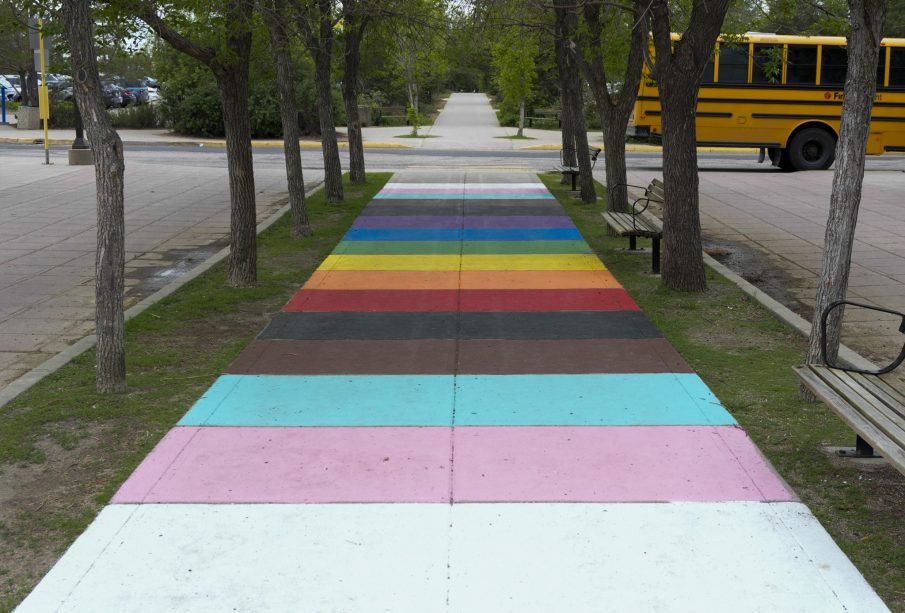
The case raises questions about children’s rights and the limits of Canada’s Notwithstanding Clause
There have been many legal battles involving the University of Regina these past few years.
Perhaps the most prominent is UR Pride’s ongoing lawsuit against the Saskatchewan government’s controversial Bill 137.
Passed in October 2023, Bill 137 — An Act to amend The Education Act, 1995 respecting parental rights — mandates parental consent for students under 16 to use different names/pronouns at school.
Critics point to data showing that historically, 2SLGBTQ+ youth are at higher risk of rejection, psychological and physical abuse, and even being kicked out of home by parents. Critics also note this policy essentially forces teachers to ‘out’ trans and nonbinary students to potentially hostile parents.
UR Pride executive director Bridgit O’Brien says that though some refer to it as “the parental bill of rights, people should reject that categorization.
“This is not its name,” says O’Brien. “And any time that it’s referred to as that, it grants the Bill legitimacy that it does not have.”
“Nobody knows.”
There have been 26 interveners, with provinces including British Columbia and Quebec supporting UR Pride’s lawsuit, while Alberta is against it.
“An intervener is an organization that seeks to include arguments that the initial plaintiff has not had the opportunity to include, or may have missed,” says O’Brien.
Despite the case’s national attention, O’Brien says UR Pride could use some local back-up. “[We] do not have the support from campus community,” she says, because “nobody knows about it.”
Consider this Pride Month update a small effort to remedy that.
If the Supreme Court decides that lower courts do not have that jurisdiction, that essentially means the end of rule of law in Canada
Where’s it all at?
Here’s what is going on with the lawsuit, bullet-pointed for your coffee-shop, bus-riding and bathroom-reading convenience.
• The Province’s Saskatchewan Party government announced its intent to pass so-called ‘parental rights’ legislation in summer 2023, shortly after achieving a tighter-than-expected byelection win in the previously safe Lumsden-Morse riding. The vote split Sask. Party support between the ruling Party and other, more right-wing conservative candidates.
• On Sept. 28, 2023, Court of King’s Bench Justice Michael Megaw granted an injunction against Bill 137, finding evidence of potential irreparable harm to students while the case proceeded.
• On Oct. 20 that year, Bill 137 was passed despite critics thoroughly and repeatedly outlining the dangers it posed to trans youth.
• The Government of Saskatchewan did an end-run around Justice Megaw’s injunction by invoking Section 33 of the Canadian Charter of Rights and Freedoms, the Notwithstanding Clause. The Clause lets governments override Charter rights, which Bill 137 likely would be found to violate. The clause must be renewed every five years.
• UR Pride asked the court for permission to amend its original claim to say the Bill violated both Charter Section 7 (life, liberty, and security of the person) and Section 15 (equality rights for every individual), along with violating Section 12 (protect individuals from cruel and unusual treatment or punishment).
• The government counter-argued that due to the notwithstanding clause, the court no longer had the jurisdiction to rule on alleged Charter violations and the lawsuit should be dismissed.
• The chamber judges allowed the lawsuit to continue despite the notwithstanding clause, saying it still had jurisdiction to hear charter claims under Section 7 and 15 even when Section 33 is invoked.
• The Saskatchewan government appealed to the Court of Appeal decision to the Supreme Court of Canada, which agreed to hear the case last November.
And that brings us up to date.
It might be unlikely Saskatchewan’s use of the Notwithstanding Clause can be fully overturned in this case. Nevertheless, O’Brien says it’s still important to determine if Bill 137 violates Canada’s Charter of Rights and Freedoms.
She says if the court loses the ability to review laws passed using the Notwithstanding Clause, it would weaken constitutional rights across Canada.