Maysa Haque and Aasif Bulbulia talk about Muslims-Indigenous relations and political engagement
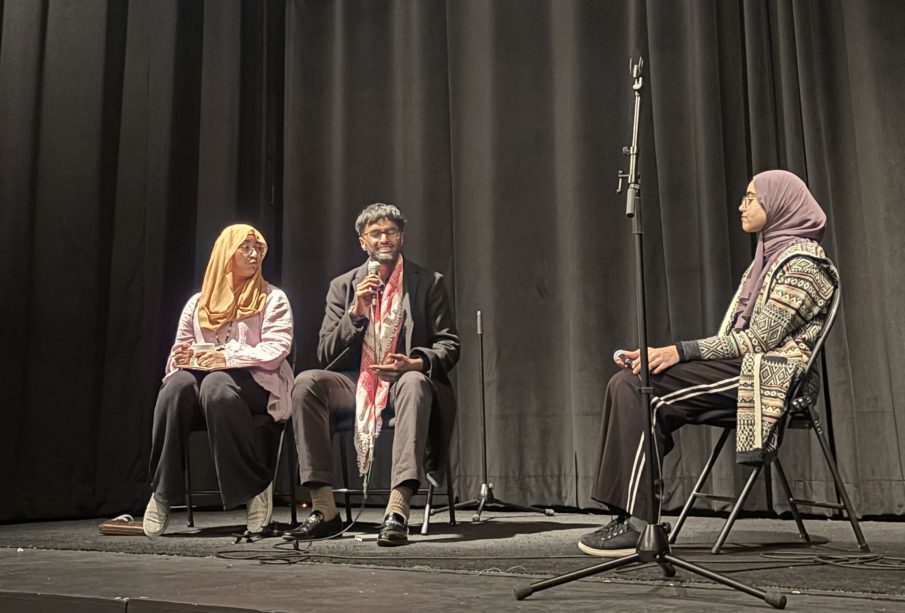
“Can the Muslim speak?” is a question on the minds of many who follow Islam, particularly in the West, given the stereotypes associated with their identities. Aasif Bulbulia and Maysa Haque, both involved in the Regina community, explored this question, specifically in relation to Treaty 4, during an event at the Artesian on Oct. 20.
The event was organised by the Hampton Project in partnership with the Regina Youth Leadership Institute (RYLI). The original speaker lineup included Bulbulia, a poet, educator, and youth and community engagement officer at RYLI; Haque, a University of Regina (U of R) alumna and educator currently pursuing a PhD in Gender, Race, Sexuality and Social Justice at the University of British Columbia (UBC); and Lubna Daldum, a current U of R student and digital content creator who uses her platform for humanitarian advocacy. However, Daldum couldn’t attend the event due to unavoidable academic commitments.
Apathy towards Canada’s colonial past
Drawing from his experience as an immigrant, Bulbulia talked about the “pressure to assimilate” into Canadian culture and buy into the narratives of a “multicultural” country.
However, many newcomers who are unaware of Canada’s Indigenous history may also accept misinformation. Immigrants often come to the West seeking a better quality of life, and many focus on earning a living and achieving academic success.
To those individuals, Bulbulia said, “It’s not sufficient to just come here and make your money and provide for your families.”
However, acknowledging this apathy towards learning is the first step, and according to Haque, even that is absent within some Muslim communities.
“But in general, you don’t find that even the talking in our communities is happening,” said Haque.
We’d much rather talk about the halal fest invading Regina instead of addressing the fact that hundreds of our neighbours are without roofs. –Asif Bulbulia
Uncomfortable conversations
Haque talked about how older generations of Muslim immigrants may be more vulnerable to misinformation, but can also learn from younger generations. Since many high school curricula now include Indigenous history, younger people may be more familiar with the topic.
“The very basic thing is literacy, but literacy at all levels of the community. So, some of that falls on young people to do,” Haque said.
Haque also discussed Project of Heart, a class she teaches through Luther College, which is federated with the U of R, as part of her PhD research. It’s a non-credit class open to the community in which she teaches about the history of residential schools in Saskatchewan. Many students in the class are older adults and Indigenous peoples who want to learn more about their history.
For her research, Haque also collaborated with Muslim elders, which proved to be a challenging experience because some had been exposed to harmful stereotypes about Indigenous people, including the misconception that all Indigenous people are “drunk alcoholics.”
“In my base ground interviews, just the things that I was hearing were so upsetting to me,” Haque said.
This experience made Haque realise the importance of educating her own community, despite the discomfort involved.
“Because in my opinion, part of literacy is having those conversations. And it really sucks. It’s really uncomfortable […] It’s better for me and my own community to do that work with the elders… [it’s] my responsibility,” said Haque.
Involvement in city politics
Bulbulia discussed RYLI’s efforts to get young Muslims involved in Regina’s municipal politics. As part of these efforts, he has collaborated with local politicians, such as Ward 6 councillor Victoria Flores.
“We had a session with councilor Flores a few weeks ago on local projects,” said Bulbulia.
“In RYLI with this [Civic Youth Fellowship] program, where we are trying to create space for young Muslims to learn more about what does it mean to engage with municipal politics,” Bulbulia continued.
However, he also warned racialized communities of the prejudices and stereotypes associated with their identities and the scrutiny they may face as a result.
Bulbulia gave examples of Muslim figures in North American politics, including Zohran Mamdani and Abdul El-Sayed, who have also been scrutinized for their faith by both the press and the general public. According to Bulbulia, one of the reasons behind this Islamophobia in politics is to distract people from more pressing issues.
Connecting this to Regina’s municipal politics, Bulbulia also discussed several local concerns.
“We would much rather talk about the call to prayer in the downtown area than we would try to understand why is the city spending $130 million on policing, right? […] We’d much rather talk about the halal fest invading Regina instead of addressing the fact that hundreds of our neighbours are without roofs,” said Bulbulia.
Bulbulia emphasized that Regina residents should focus on the similarities between different communities. He argued that, regardless of religious beliefs, ethnicity, or race, working-class people have more in common with one another than with “millionaires and billionaires.”