
Nature Saskatchewan issues warning, drivers should slow down as tiny local salamanders begin crossing roads
For most people, late summer means the beginning of a new school year, cooler nights and the last stretch of summer. For Saskatchewan’s western tiger salamanders, it means moving.
Young salamanders are leaving the wetlands where they were born and travelling across the landscape in search of a new habitat, a journey that can put them at risk, directly on the path of vehicles.
Nature Saskatchewan issued a warning on Aug. 19 about the late summer movement of tiger salamanders, Saskatchewan’s only salamander species.
Hard to spot on the road
The organization says juvenile salamanders that have recently developed legs and emerged from their birth ponds begin migrating in summer.
“They often come in conflict moving across roadways this time of year and are not fast enough to avoid traffic,”said Emily Putz, habitat stewardship coordinator with Nature Saskatchewan.
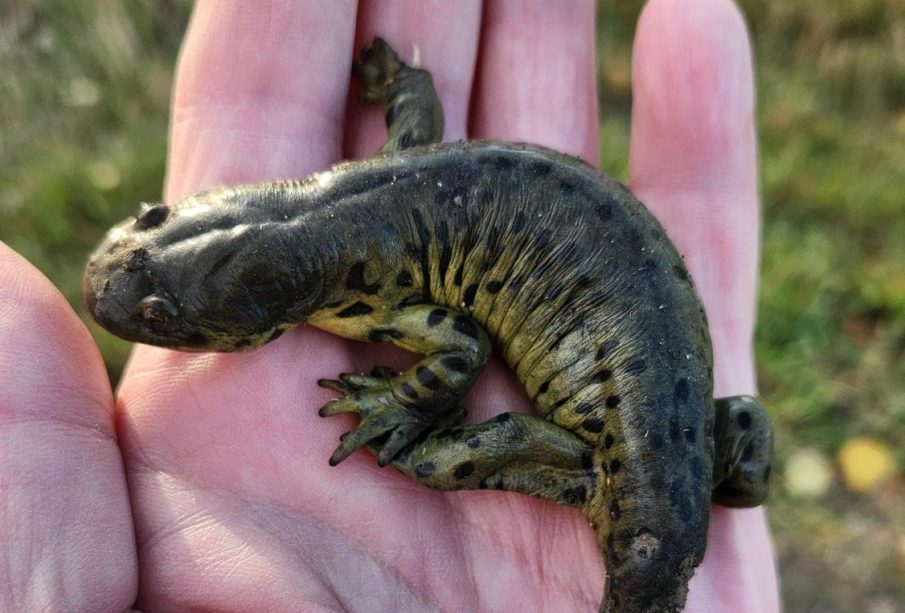
The western tiger salamander’s appearance can make it easy to overlook. They have a black and yellow or cream coloured markings that generally fade as they age, eventually becoming more uniformly olive green to grey.
If it is safe to do so, and you see a salamander cross the roadway in front of you, slow down and take a minute to avoid them. -Emily Putz, habitat stewardship coordinator with Nature Saskatchewan
U of R professor’s perspective
The Carillon also asked Dr. Christopher Somers, a professor in the biology department, about where we could see the tiger salamanders. “Salamanders are present in and around the city of Regina but not in very large numbers. They tend to be in more rural areas on the outskirts of town. Road mortality can be a threat near wetlands that provide breeding and overwintering habitat for this species. Wascana Lake near the University of Regina campus likely has some salamanders,” he said.
Upon asking why he thought the tiger salamanders were important for the ecosystem, he said, “Insects would become more abundant if salamanders disappeared. Salamanders are also prey for other animals, such as pelicans, and represent a valuable food resource that would also be missed. In both instances, impacts around the city and on campus would likely be marginal given that salamander populations are not very large. However, in places like Salt Coast, Saskatchewan, which has thousands of salamanders and large migration events, removing the salamanders could cause major ecological impacts.”
Why the species is important to the ecosystem
Although small, the animals play an important role in prairie wetlands. Their larvae are completely aquatic, and both the larvae and adults help control insect populations in fishless wetlands.
“The larvae and adults both cover an important niche, controlling insects in spaces that don’t host fish,”Putz said.
But the animals face more than traffic. Their habitats are disappearing as small wetlands are drained for agriculture. The terrestrial prairie, where adult salamanders overwinter, is also declining. Nature Saskatchewan says the species is additionally vulnerable to aquatic pesticides and a virus affecting salamanders across Canada.
Nature Saskatchewan is asking drivers to slow down if they see a salamander cross the road. The organization says drivers should never put themselves or animals at risk to avoid a certain animal. For students, this is also a reminder that not all Saskatchewan wildlife is large enough to catch someone’s attention.
Putz said Saskatchewan is a stronghold for Western tiger salamanders in Canada. “If it is safe to do so, and you see a salamander cross the roadway in front of you, slow down and take a minute to avoid them,”Putz said.
People who spot a tiger salamander can also report the sighting to Nature Saskatchewan’s Stewards of Saskatchewan program, which keeps reports private and uses sightings to help track where populations of species at risk are found and how their range might change.
I saw a bear when visiting Banff, Alberta. However, I was not aware of tiger salamanders. I was expecting to see big wildlife here. – First year engineering student Ananaya Patel
U of R student perspectives
Chloe Brown, a third year biology student said, ”Many students are not aware how important this species is in Saskatchewan. These animals help keep insect populations under control by eating them, helping keep their numbers balanced so another species doesn’t take over a pond without fishes.”
Sarah Desheay, a second year environmental student said, “A student club should put in signs near high risk wetlands or put posters up on campus to create more awareness, as a lot of students do not know about these species. I know a lot of students that drive home, so reading posters about it on campus might help them slow down.”
Ananaya Patel, a first year engineering student, said this was the first time she heard of the species. “I saw a bear when visiting Banff, Alberta. However I was not aware about tiger salamanders. I was expecting to see big wildlife here. I drive around with friends, and I think it is important for people to know so the species doesn’t get injured.”
A shared responsibility for Saskatchewan
The annual march of the western tiger salamander is a reminder that humans and wildlife share the same prairie landscape. While large animals usually grab headlines, it is also important to save the smaller wildlife that help preserve Saskatchewan’s ecosystems. By slowing down on roads, reporting any sightings, and spreading the word, the community can ensure these creatures survive their journey.
What you can do to help
If you spot a western tiger salamander on the road or in your yard, or near a local wetland, use the resources below to log your sighting or learn more about these species at risk.
Report by phone: call the Nature Saskatchewan Hoot Line, (306) 780-9273 or 1-800-667-4668 (HOOT). You can also report by email: send in your name along with the exact location and number of salamanders you saw at outreach@naturesask.ca.
You can also visit their news portal to read more on the wildlife advisory for this species: https://naturesask.ca/resources/news/tigers-on-the-prowl-tiger-salamanders-in-sk