
A reflection on the decommissioning of houseless encampments in Sask
Homeless encampments both in Saskatoon and Regina were decommissioned last month.
Hundreds of people were removed on the corner of 20th St. and Ave. K South in Saskatoon and Pepsi Park in Regina by Fire and Protective Services due to fire risks and safety concerns.
These events made me reflect on my own experience earlier this year, one that has left me deeply unsettled.
They do drugs. They overdose, panhandle on the street! There could be needles. These houseless people are a risk. What if there’s a fire? -Katie Flath
The life changing moment
I threw a person’s life away. Literally!
It was my first week of work during May 2026 in my second season as a parks labourer for the City of Saskatoon.
Someone had sent in a complaint about an encampment along the riverbank, so myself, my Park Technician 9, and two other coworkers drove down the walkway of Lower Cosmo, a lower hiking trail in Cosmopolitan Park on the east bank of the South Saskatchewan River.
The trail overlooks the river, offering a clear view of the castle-like Bessborough Hotel. Above it sits the multimillion-dollar homes along Saskatchewan Cres. East.
I remember feeling worried and anxious, wondering what we were going to find.
Through the leaves, we eventually spotted an opening in the bushes. There we parked, hopped out of the truck, and headed further into the trees toward a small makeshift home.
“Be careful and watch where you step,” my park-tech told us. “Watch out for needles.” But we never found any.
Instead, as we pushed further into the bush, we discovered a living room complete with dug-out seats. A small kitchen area with a stove made from discarded metal and dented pots. A set of stairs which lead to a woven wall of branches and a tarped-up bedroom with a single cot.
I was invading a personal space and shelter. It was a house.
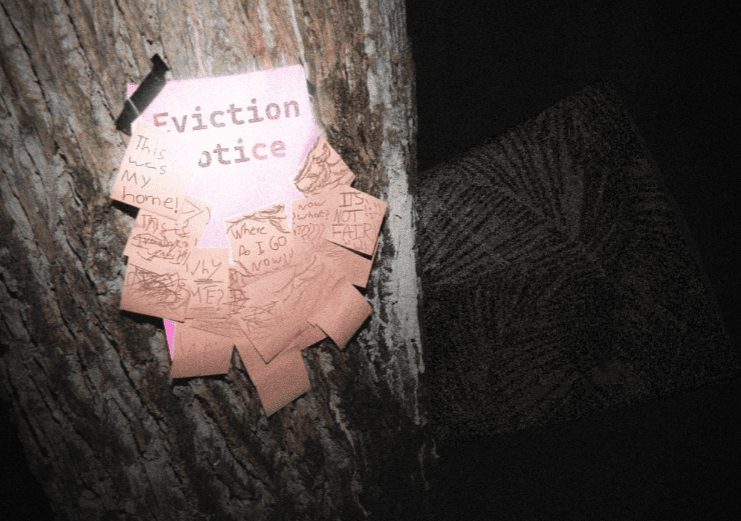
My coworkers and I had brought garbage bags, and we began cleaning up the site. Stapled to a tree was a pink notice from the fire department. It confirmed that fire bylaw inspectors assessed the site and determined the person living there had to leave because of safety and fire risks.
I understood this was part of my job. But somehow the thought didn’t make it any easier.
The throwing away process
The pink paper was covered in handwritten notes, a full annotation of the eviction notice. Questions about where this person was expected to go, what they were supposed to do with the few days they were given to leave, and why they were forced to abandon their “home” filled the page.
I wondered the same thing.
Slowly, garbage bag after black garbage bag began to fill. We threw away what we assumed had been left behind. I would walk back to the truck, toss another bag in the trunk, and return to collect more.
With every trip, the weight on my shoulders seemed to grow heavier. Eventually, tears pricked my eyes.
I remember going up to the sleeping area and finding notes in journals written in pencil and black sharpie. They shared small snippets of this person’s life and their story.
Pages described their past. Told us that they went to school. That they had a child when they were nineteen. That they didn’t choose to end up in this situation.
I quickly glanced at an open day planner with an appointment penciled in to visit the Calder Centre, a provincial addiction treatment centre on Arlington Ave. in Saskatoon, for May 17.
I hoped they could make it to the appointment.
Under the cot there were different pairs of shoes, jackets, a toiletry bag, and a hole stitched messily with fabric.
My coworker found a Métis sash, something particularly difficult for her as a Métis woman. I vividly remember a tie beaded in yellow, orange, and blue.
“This is one of my favourite books,” said my coworker as she picked up The Lightning Thief, a Percy Jackson novel by Rick Riordan, from where it laid beside the cot.
All these things were placed into garbage bags.
And with every item and personal belonging, I felt increasingly guilty and ashamed. But isn’t it my job?
I would walk back to the truck, toss another bag in the trunk, and return to collect more. With every trip, the weight on my shoulders seemed to grow heavier. Eventually, tears pricked my eyes. -Katie Flath
Growing questions
I was there to help clean up an encampment and address what the City of Saskatoon describes on their website as “significant health, safety, and access risks.”
Yet, standing there, it felt like a complete invasion.
What if this person were to come back? What would they do when they found nothing? When they realized their food, their shelter, their clothes, their writing, and their personal belongings had been collected and discarded in a single morning?
Where will they go? Will they survive?
I was devastated!
“Oh, you’re finally getting rid of all that junk,” said a couple walking by as we threw the last bag away. The cherry on top. I felt disgusted for being part of such a process.
Yes, one could argue; “they aren’t supposed to be there! They do drugs. They overdose, panhandle on the street! There could be needles. These houseless people are a risk. What if there’s a fire?”
But does that justify throwing away someone’s belongings?
According to the Canadian government, there are an estimated 65,000 people who experience homelessness in Canada. On Nov. 5, as part of the 2026 Budget, the federal government set a goal to end homelessness within 10 years. The budget proposes $11.2 billion over the next four years and $17.8 billion in future years to assist Canadians experiencing homelessness..
Will this be enough?
Currently cities like Saskatoon or Regina plan “cleanups” that displace hundreds of people living in these single encampments and houseless communities.
Will municipalities and provincial governments step up to provide the ongoing operational funding and healthcare support needed to make a lasting difference?
I’ll never forget this faceless, nameless person whose belongings I was asked to throw away. And I often think of how I was part of a system bringing them down.