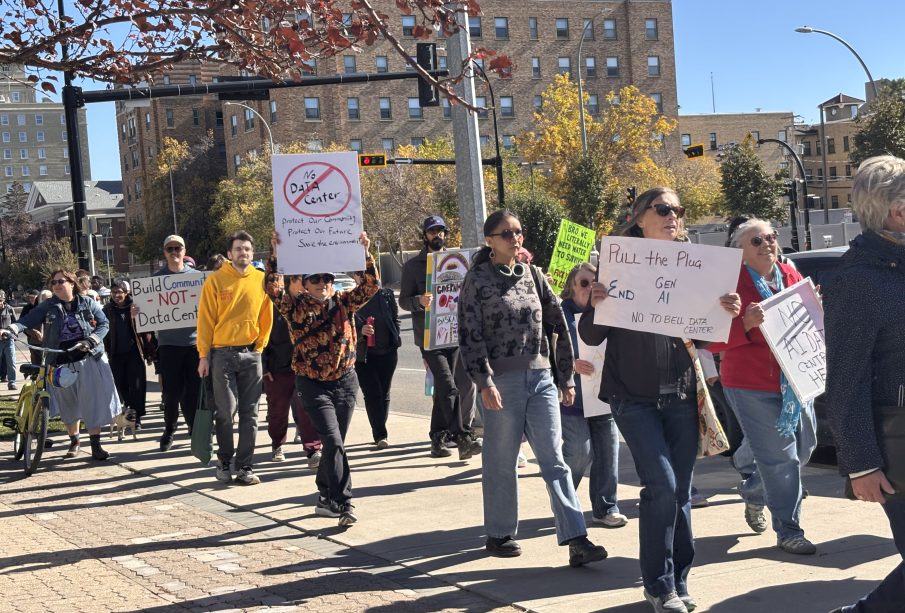
Protesters gathered in front of city hall and marched around downtown Regina
Oct. 3 was the National Day of Protest against AI data centres, several demonstrations held across cities in Canada and the United States. For Regina, this meant marching against the current construction of the hyperscale AI data centre and continuing to demand transparency from the Saskatchewan Party government and from city council.
Approximately 50 protesters gathered in front of city hall and marched around downtown Regina in the afternoon with signs reading messages such as “build community not data centres,” “planet over profit,” and “we cannot eat money.”
Bell Canada CEO Mirko Bibic stood alongside Prime Minister of Canada Mark Carney and Saskatchewan Premier Scott Moe on Sept. 14 to announce the expansion of the AI data centre in Saskatchewan.
What was originally supposed to be a 300-megawatt facility became enlarged to 1.2 gigawatts of power, with the investment jumping from $1.7 billion to $52 billion, “the largest capital investment in Saskatchewan’s history,” according to Carney.
This data centre is projected to sit just south of Regina in the Rural Municipality of Sherwood, between Range Road 2149 and Old Highway 16, supported with the partnership of the Government of Saskatchewan and George Gordon First Nation (GGFN).
Taya Triffo, one of the organizing members of No Data Centres on Treaty Land, led the Oct. 3 rally alongside other speakers, including Cali Longman, Taran Ulrich, James Murray, and Dilynn Kehler.
“As Native people, the environment should be our first priority, our environment and the people on this land,” said Longman.
Longman, a GGFN member, pushed back against the partnership of GGFN, as the economic arm George Gordon Developments is currently contracted as a builder and partner of the project.
She spoke out against their compliance with the Government of Saskatchewan and Bell, saying that they have forgotten about their dedication to the environment of this land, to the animals and to the people, all just for more money and more jobs.
As Native people, the environment should be our first priority – our environment, and the people on this land. -Cali Longman, a member organizing the rally
Organization
Nicholas Fuzesy, a fifth-year computer science student, has been involved with No Data Centres on Treaty Land since the beginning of April after attending its first protest.
Fuzesy urges a moratorium to delay the expansion of the data centre and to have a proper environmental assessment impact, which has not been done by the provincial governments.
Since the announcement of the construction of the AI data centre, many concerned residents around the province and members of the organization have reached out to Darlene Rowden, the Minister of Environment. Since then, they still have not heard back from her on whether or not an environmental assessment was processed.
Fuzesy continued to highlight that the citizens of the province, Regina residents and citizens of George Gordon First Nation, need “to have their voices legitimately heard by the people in council, and not just have corporations such as Bell be the driver of what happens with this land.”
He continued to echo that the Sask. Party is not listening to their concerns.
“They have an outcome they want, which is to have the data centres to be built in order to appease Bell,” he said.
“They don’t care about what people think. They just care about making money. They care about economic interests,” said Fuzesy.
Fuzesy also highlighted the fact that Scott Moe and the Sask. Party have recently made ads on TV and on Youtube that are “damage control.” On Sept. 15, a video titled “Home ice matters” was published on Scott Moe’s Youtube channel.
Fuzesy explained that the goal of the Sask. Party seems to be to “convince Saskatchewanians that the centre is a good idea and to evade inviting the public to give their own perspectives.”
They don’t care about what people think. They just care about making money. They care about economic interests. – Nicholas Fuzesy, a fifth-year computer science student
Student concerns
Fourth-year arts and sociology student Gabriela Bernal Saenz criticizes the Sask. Party’s deflection of listening to the voices of concerned residents.
“It shows their true colours and it just reflects how little they care about how the public feels because they work for us, so they should be listening to us,” she said.
She adds that if the data centre came in under private development, it still has a big impact on Regina residents, on the resources available to us, and the land we live on.
Bernal Saenz continued to voice her frustrations on the misuse of investment money with it being put towards the AI data centre instead of improving Saskatchewan’s healthcare, education, and housing. She mentioned that the development of technology is not essentially being geared towards improving our quality of life.
“[They are doing this] instead of going for issues that are much more serious right now, like people dying on the streets, housing security, and food security. It makes me very angry that they are just looking past that,” said Bernal Saenz.
Ariel Galloso, a second-year creative technologies major with a certification in animation, voiced her concerns on the uncertainty of her career being affected by AI in the future. She shares the same sentiment of no one listening to public concerns, especially with the younger generation.
“We’re all digging ourselves a grave to rest in because it’s not good and they are showing their true colours, their true interest, which is money,” said Galloso.
In store for the future
No Data Centres on Treaty Land is working towards “a bill in the Rural Municipality of Sherwood that would impact the low frequency noise that comes from the data centres,” said Fuzesy.
In addition, they continue to write letters to Roden pressing on for a full environmental impact assessment and handing them in. The current letter count is from 500 to 600.
Fuzesy insists on clarity and change, striving to be a figure who makes it clear that people of the city of Regina and of Saskatchewan will not lay on their backs and let the decisions and construction move forward.
“We were out, we were fighting, we were letting our voices be heard throughout this process, and we didn’t want this,” he said.