Nikolas Boily discusses his work with supernovas
So, I am back with another science-based article. At this point it has become a personal side quest to have a Rolodex full of cool researchers that I have spoken to.
This time, I present to you the research project of a University of Regina (U of R) student in Dr. Mauricio Barbi’s lab in the department of physics. Graduate student Nikolas Boily studies supernovas which are massive explosions that mark the end of a star’s life. I had the opportunity to connect with him and learn about his project.
Boily’s grad project
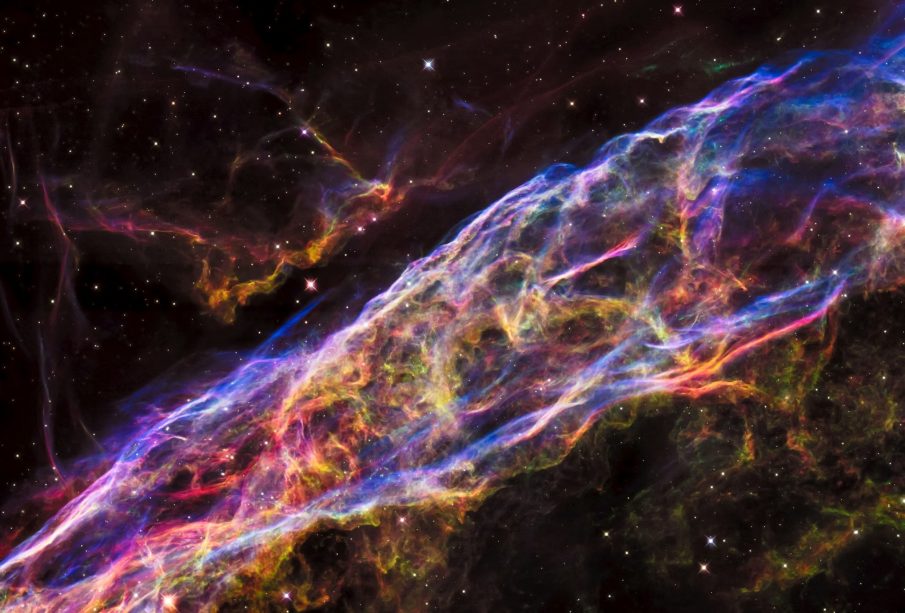
Boily shared he studies the neutrinos that are released during supernovas. Neutrinos are very small massless subatomic particles. He explained that supernovas happen when stars which are approximately eight times the mass of the sun or more run out of fuel and implode.
The light emitted by stars is a result of fusion reactions occurring at their cores. These reactions also generate energy which balances the gravitational force. When a heavy star runs out of fuel it implodes under gravitational force. This event marks the final stage of a star’s life.
During a supernova a huge amount of light and neutrinos explode out of the dying star. Boily shared that this explosion is called a shock breakout.
“There are cases in history where people have looked up at the sky and seen a star appear and that star is visible during the day as well. That is a supernova. It’s a very large amount of light coming out. We can characterize what happens when that supernova happens [and] what’s going on physically,” he explained.
Large detectors like the Super-Kamiokande neutrino observatory in Japan can detect neutrinos which are otherwise invisible. While neutrinos can be released by many sources, Boily studies the ones that are released during a supernova. Detecting supernova neutrinos helps locate where it happened.
“What we’re able to do is reconstruct how all those particles came in and then back calculate where they came from. But that process takes a long time.”
Boily shared that he is working on a technique that would help speed up the process of detection. “The entirety of my research is computational based. So, I write a lot of coding scripts, data analysis stuff, and in one way you could say that it’s a [computer science] project, but it’s applied to physics.” He hopes to build models that can reduce the detection time to less than a second.
The path that led to the U of R
Being a U of R student was not always the plan for Boily. He finished his undergraduate degree in physics and astronomy from the University of British Columbia (UBC), Vancouver. His experience in research started when he was an undergraduate student. “I worked in my fourth year for a thesis project in collaboration with the Laser Interferometer Gravitational-Wave Observatory.”
The Laser Interferometer Gravitational-Wave Observatory (LIGO) was the first to detect gravitational waves that pass through the Earth in 2015, a century after they were predicted by Einstein’s general theory of relativity. The detection helped in confirming Einstein’s theory. Having the opportunity to work with LIGO played an important role in inspiring Boily’s interest in astronomy and astrophysics. “[…] that’s where I got interested in physics and astronomy, but specifically with the astrophysics side of things.”
After finishing his undergraduate degree, he worked for the Pacific Northwest National Laboratory at the Hanford Site in southeastern Washington State. Some of you might be familiar with that name. It is the same site where Oppenheimer’s team enriched uranium. Boily worked on a project that involved detection of chemicals inside nuclear waste which he explained is a big part of the clean-up. He believes that his background in physics helped him apply his analytical skills on a chemistry-based project.
“Science is kind of intermingled in all these things. You get trained into doing things. You can always apply that to a larger place.”
There are cases in history where people have looked up at the sky and seen a star appear and that star is visible during the day as well. That is a supernova […] We can characterize what happens when that supernova happens [and] what’s going on physically.” – Nikolas Boily, grad student, U of R
Choosing a grad project
It was after being a part of this project for approximately two years that he decided to come back to academia and chose the U of R for it. He shared that the two biggest reasons to come back was the support and motivation offered by his parents and his longing to work on a physics-based project.
“My parents have PhDs in chemistry, and they support me in trying to go do my higher degrees and things like that. And then, I guess the other aspect is [that] I wanted to go back into physics as much as the chemistry and all that was interesting. What I really love is doing research with astronomy and astrophysics.”
He shared that he was advised to pick a good supervisor and a project that he would enjoy working on for his graduate studies. “For a graduate, you’re picking what you want to work on, and also in a way, where do you want to live.” During his search for a graduate project, he came across U of R’s post about physics research in supernova neutrinos which he applied for. He shared that at the time of applying he had not heard of Regina and was unsure what the city was going to be like. After having lived in the Queen City for some time he has come to the conclusion that he quite likes it here.
“I enjoy it here. I personally love the winter. I like the cold. I like the snow. I think it’s fun. It’s like you’re going out on an adventure every single time you go outside,” he chuckled.
The Barbi lab
Dr. Mauricio Barbi’s research lab in the department of physics is located in the Lab Building and is full of interesting projects in two major disciplines which are palaeontology and particle physics.
The palaeontology section of the lab uses concepts of particle physics to develop studies in palaeontology. Jerit Mitchell, a PhD student in the lab, explained that they were able to find mineralised blood vessels in a healed over fractured rib of our very own Scotty the t-rex by applying techniques from particle physics.
The second part of the lab conducts research in particle physics. Postdoctoral fellow, Luan Koerich, shared that one of the big projects that the lab is working on in collaboration with many Canadian and international universities is building the Hyper-Kamiokande detector which detects neutrinos.
A detailed breakdown of both the projects and information about major collaborators can be found in the first episode of the Carillon’s Labs of U of R video series which can be found on our Instagram and TikTok pages.
Advice for aspiring researchers
Boily’s advice to aspiring researchers is that they should enjoy whatever they choose to do. “That’s what’s important about all this, I mean, you yourself being happy with all the research and anything that you want to do,” he said.
Boily is now moving into the second year of his graduate studies and the Carillon’s team wishes him all the luck with his project!