Wetlands drainage increases annual carbon emissions by 5 per cent
A recent study published in the international science journal FACETS reveals that draining small agricultural wetlands in Canada’s prairie pothole regions is substantially increasing national greenhouse gas emissions by at least 5 per cent annually. To understand what this yearly increase means for the Earth, and how it impacts different countries, the Carillon connected with two Saskatchewan-based researchers who were among the authors of the paper – Dr. Kerri Finlay and Dr. Colin Whitfield. Dr. Finlay is a University of Regina (U of R) professor and director of the Institute of Environmental Change and Society (IECS) and Dr. Whitfield is a University of Saskatchewan associate professor in the school of environment and sustainability.
Dr. Finlay’s research focuses on aquatic ecology and biogeochemistry. More specifically she focuses on analyzing the role of prairie lakes, wetland ponds, and reservoirs in the global carbon budget, as well as the impacts of human based activities on water quality. Dr. Whitfield’s research on the other hand focuses on understanding how human behaviors influence natural systems and how stressors like land use and climate change affect hydrology and the movement and biogeochemical cycling of carbon, sulfur, nitrogen, and other naturally occurring elements.
Wetlands serve multiple purposes
“I believe our research in the FACETSarticle is providing additional evidence to support how invaluable wetlands are on our landscape,” said Dr. Finlay in an email to the Carillon. Dr. Whitfield found it rewarding to work with the team, and he is optimistic
about this study. “I believe this study provides a good example, because it was conducted by a team of academics, researchers, producers, and members of industry groups. It was rewarding to work with such a team because the approach we took was guided by a number of different perspectives and sets of expertise, and not from a single disciplinary focus […] I believe this strengthened the overall work and its results,” said Dr. Whitefield.
Dr. Finlay suggests that the roles of wetlands in improving water quality and groundwater recharge are usually well-documented. We have known for a long time that wetlands provide numerous ecosystem services, including improving water quality, providing water management strategies like reservoirs during droughts and floods, groundwater recharge, and providing habitat for birds and animals.
Wetlands as natural carbon sinks
She, however, believes that we have not fully appreciated the role that wetlands play in carbon capturing in the prairie pothole region.“The carbon storage in these wetlands is vast, and draining them would release significant amounts of greenhouse gases into the atmosphere,” she cautioned. Dr. Whitfield acknowledged that while we have frameworks to account for green- house gas (GHG) emissions from different industries in Canada, wetland drainage has not been accounted for previously. “We now understand that the magnitude of GHG emissions associated with wetland drainage in the prairie pothole region is large and suggests that we are underestimating industrial emissions by not accounting for these land-use changes […] Inclusion of this approach in the National Inventory Report would provide us with a more comprehensive picture of emissions,” he explained.
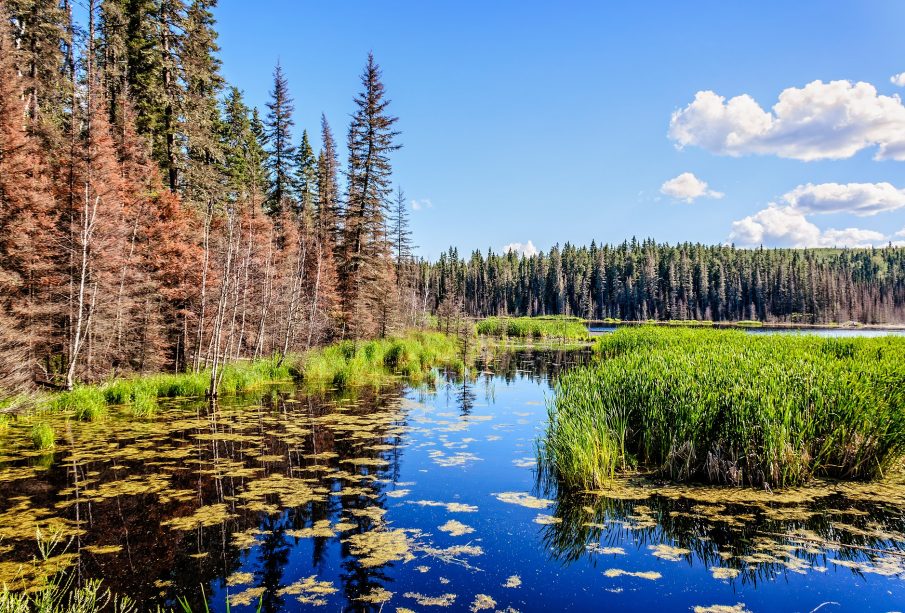
To understand the rationale behind why draining a small pond can have a massive atmospheric impact, one must look beneath the water’s surface. Wetland sediments are naturally very rich in organic matter that supports plants, algae, and microbes. “When these organisms die, they settle into the bottom of the pond and accumulate as sediment,” Dr. Finlay explained.
Under the cover of water, this organic matter remains stable because there is not a lot of oxygen, so processes that would break them down proceed very slowly. Dr. Whitfield noted, “with time, carbon accumulates under these conditions. When wetlands are drained, soils rich in carbon become exposed to oxygen, promoting conversion from organic forms to carbon dioxide, with subsequent release [or emission] to the atmosphere.”
Growing emphasis on transdisciplinary approaches in research as being key to ensuring that science is working in a way that addresses real-world challenges we face.” – Dr. Colin Whitefield, associate professor, U of S
Local land, global impact
The effects of this drainage can be felt in Saskatchewan and Manitoba as the yearly 5 per cent loss of carbon storage physically changes the flood and drought resilience of these provinces. “The 5 per cent number is additional GHG emissions, relative to current agricultural emissions. Estimates of the current loss rate of wetlands are a bit difficult to get at. But any loss of wetlands on the landscape is going to reduce our ability to be resilient to floods and droughts,” stated Dr. Finlay.
A new blueprint for research
Dr. Finlay acknowledged the role that post-secondary and academic institutions play in interdisciplinary research. She points out
that to solve regional problems with global impacts, universities must evolve through interdisciplinary research. However, she also explained that the traditional “publish or perish” model can often limit creativity and make interdisciplinary collaboration more difficult. Dr. Whitfield said that “growing emphasis on transdisciplinary approaches in research [is key] to ensuring that science is working in a way that addresses real-world challenges we face, while also helping ensure the science can be used by practitioners and in finding solutions to these problems.”
To combat this, Dr. Finlay suggested that, “universities can help by broadening what they value, giving credit not only for peer-reviewed publications but also for things like community engagement, interdisciplinary work, and research that’s meant for broader audiences.” Dr. Finlay points to her experience at the U of R as a positive example, noting a strong sense of community that encourages collaboration and work beyond disciplinary isolation.
Advice for future researchers
Researchers who address these complex challenges should be comfortable going deep into muddy wetlands, and most importantly, they should recognize that addressing climate crises requires more than just raw data. It also necessitates a shift in how we value the land and how we train the people who study it. For young scientists entering the field of sustainability, Dr. Finlay’s advice is rooted in exploration and intuition. She urged students to expose themselves to “lots of different opportunities and to seek out courses that present ideas and concepts” that they hadn’t thought about before.
Finlay also called upon students to take a proactive step toward mentorship. She strongly suggested that students reach out to professors and graduate students, even for a simple conversation about their work or to explore summer research opportunities and independent research courses.
Ultimately, she believes that the most sustainable career path is one driven by genuine interest and passion. “My overarching advice to students is to trust your gut, notice what makes you excited and conversely what makes you say ‘meh’ and follow the path that allows you to get more excited more often,”she said.
Dr. Whitfield concluded by asking students to “be informed, be active, and use your voice to get involved. Groups of people, even small ones, can effect change when they work collaboratively.”