U of R professor addresses prevailing social issues in the West
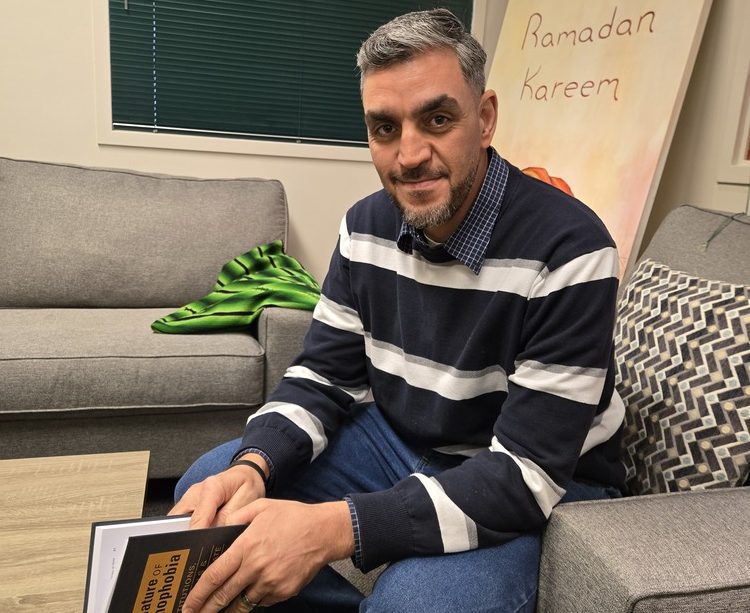
Have you ever talked to someone whose brutal honesty and realistic approach towards their work intrigues you immensely? Well, I did! I interviewed Dr. Amin Asfari who is a professor in the department of justice studies at the U of R.
Asfari joined the U of R in Fall 2024 as an associate professor in the department of justice studies and currently serves as a chair for Law Foundation of Saskatchewan in police studies.
While I was gathering background information and researching about him, his credentials made me wonder why would an overachieving academic like him decide to move to our teeny tiny city of Regina? So, I commenced my interview with that question.
“[North America] has a lot of private institutions, about 3000 plus universities across the U.S and something to the effect of several 100 here in Canada. That means a lot of competition,” said Asfari. “So the university where I came from in Colorado wasn’t doing financially too well. And so that, coupled with my desire to engage more broadly in research, led me into this position.”
Asfari’s research revolves around racialized minorities, specifically Muslims, their interactions with the justice system, and Islamophobia. He has also co-authored two books on the same topic namely Jews and Muslims in the White Supremacist Conspiratorial Imagination and The Nature of Islamophobia: Institutions, Individuals, and Trickle-Down Hate.
Islamophobia and discrimination in the West
His work on Islamophobia stems from his family member being a victim of gun violence by a white supremacist.
“I see Islamophobia as a precursor to hate crimes, one of my family members was gunned down in the U.S. by a white supremacist.”
Talking about increasing discrimination socially after the 9/11 attacks, Dr. Asfari said it had a significant impact on how he theorized Islamophobia as a phenomenon. He further talked about Islamophobia being associated majorly with Arabs and not with Muslims from other parts of the world.
“If you think of Islamophobia, [you] think of the Arab. What is it about the Arab that’s interesting? Well, the Arabs have oil. A resource that [the West] wants.”
He connected Islamophobia with the West’s desire to possess natural resources from the Arab countries. And in order to accomplish that, he says, the west dehumanizes the groups belonging to this part of the world.
Elaborating on misrepresentation of marginalized communities he said, “Every accusation is often a confession […] every time you hear an accusation [on racialised communities] it’s often a projection of your own worst.”
He explained this by giving examples of how the Arabs are perceived as “one man with 4 women kind of discourse” while the “pornography industry is the Western male fantasy that they project onto the other.”
He also gave examples of stereotypes that are associated with specific groups who are treated similarly.
“[The stereotype is that] Black people are lazy, while Black people actually built the very country that is today the United States. [It is said that] the Hispanics are the lazy drug dealers but you have a fentanyl crisis among your white community. But here you call it the “drug epidemic”, not the war on drugs,” he said.
A community’s shortcomings
In addition to recognising the role that the West plays in fostering Islamophobia, Asfari also highlighted the shortcomings of the Muslim communities that do not help in altering the ongoing narrative. He says the misrepresentation of Muslims by the mass media is partly also a result of the lack of Muslims professionals in arts and humanities.
“Every immigrant [or] Muslim parent, wants their kid to be a doctor [or] an engineer. That’s a problem. It’s a product of colonialism where it’s this deficit mentality. The idea that success is money. But success is also being portrayed positively in the media.”
He mentioned how the community responded to the film, Time Hoppers: The Silk Road, which was made by a Muslim creator.
“There was a cartoon recently released and Muslims were freaking out and happy about it because, wow, we finally got representation! Well, you would have been represented if you went into media or if you went into art and film,” he said.
Every immigrant [or] Muslim parent, wants their kid to be a doctor [or] an engineer. That’s a problem. It’s a product of colonialism where it’s this deficit mentality. The idea that success is money. But success is also being portrayed positively in the media.” – Dr. Amin Asfari
Plans for the future
Asfari is currently working on a research initiative called Criminal Justice Centre for Advocacy, Research, and Education (CJ Care).
40 of his colleagues from ten countries, including Canada, United Kingdom, and the U.S. have come together to look into the impacts on and the interactions of racialized and marginalized communities with their respective criminal legal system. The research topics include the experiences of perpetrators, victims, and professionals.
“What it might look like for an African [in] Mozambique who is a police chief in England[…] or for a Senegalese person in Canada, who is a victim of a crime,” he postulated as some of the questions his initiative seeks to answer.
He said criminology as a discipline is “male and western centric” and it was “imposed by the colonial power.” One of the goals of CJ care is also to break out of it. And for that to happen the members also plan to look into the policing system and social control from the pre-colonial era.
He believes such an examination is necessary because the ideology of justice differs in different communities. As an example, he presented how the Indigenous communities don’t believe in punitive response but in restorative justice.
“For me, the research centre seeks to break the [colonial justice system] mould and understand how, if at all, this idea of criminology as a discipline exists in the world globally,” said Asfari.
Background
Born in Kuwait and raised in Brooklyn, New York, Asfari said he went “from one war zone to the next” describing New York back in the 1990s. The existing social injustices at the time led him into criminology.
Initially to address these social blights, he went into policing believing “a little bit foolishly” that the system was just. However during his time in the police academy he got accepted in the MS in Criminal Justice program which steered him toward the academic route.
“That’s what most of our students will say [when asked] why do you want to go into this field? [They will say] they want to help people. But upon closer examination, you find that in fact, oftentimes some of these very systems that purport to help people, do a lot of the damage themselves or certainly contribute to it,” said Asfari.
Teaching
Currently, Asfari teaches an “Introduction to Criminology” lecture and in fall 2025 he taught a course on community policing.
Before joining the U of R, he was an associate professor and program chair for the undergraduate and graduate criminology programs at Regis University. During his time there he made significant contributions to the program by adding a social justice and advocacy aspect to typical criminology syllabus which tends to revolve around police, courts, and correction facilities.
He said, “I think a lot of the ancillary organizations, for example, domestic violence shelters, substance abuse counselling, juvenile justice are on the periphery [of law enforcement agencies] but they take on a lot of the responsibility and they often work in tandem or in cooperation with law enforcement agencies.”
This change took the enrollment numbers from 115 students to 250 in a year. Asfari developed an advisory board of 25 organisations with differing ideologies and included organisations that wanted to defund the police system and those that were police agencies.
“I’m providing them the opportunity to provide input into the program to make it more relevant to what students are going to face in the workforce. So, what ends up happening is you have these pipelines where we can do more research with the organizations, have them give guest lectures, we can provide internship and employment opportunities to students,” said Asfari.
When asked whether he would do something like this at the U of R he said, “I did that because I was the department chair there in Colorado, I’m not a department chair here.”
The justice department at the U of R is going through a major change as they are renaming it to criminology department from May 2026. As a U of R student I hope to see this department take advantage of Asfari’s experience which could help U of R’s criminology majors significantly.