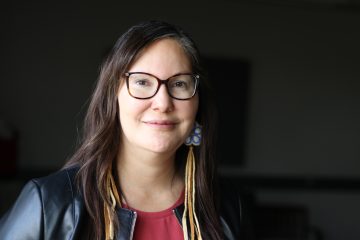
Heather O’Watch forges a global path as a Saskatchewan Indigenous advocate
In parts of Saskatchewan, many fish accumulate mercury, which is toxic to humans. People catch and eat fish, people get mercury poisoning, people suffer neurological damage.
Saskatchewan has many water bodies. Mercury is naturally found in soil and rocks. That mercury washes into rivers and lakes.
Saskatchewan also has industry. Gold mining, pulp and paper mill operation, and clear cutting can all increase mercury levels in water.
Fish accumulate mercury both through absorption and by eating mercury-contaminated prey. The big fish eat the little fish and over time, that concentrates mercury in the predators’ bodies.
And just like that, fish become unsafe to eat.
And now we arrive at the problem.
By treaty, Indigenous people have the right to fish. Indigenous communities are also disproportionately affected by mercury poisoning.
This is not good.
The Mackenzie River Basin, the largest drainage basin for rivers covering five provinces including Saskatchewan, had elevated levels of mercury in its lakes from mid-1990s to early 2000s.
That is even less good.
What is needed here is an advocate for the communities who would like to eat the fish they are legally entitled to without being poisoned.
And this brings us to Heather O’Watch.
Who is Heather O’Watch?
O’Watch is a Cree and Nakota woman from Okanese First Nation with paternal ties to Carry the Kettle First Nation. She’s had an extensive journey in advocacy, from grassroots campus activism at University of Regina in 2018 to helping shape national and international policy today.
During O’Watch’s time here, where she earned a bachelors’ degree in Indigenous Studies through First Nations University, she was URSU’s vice-president of external affairs.
Today, O’Watch works as an EDI (Equity, Diversity, and Inclusion) lead for Young Diplomats of Canada. She’s also a writer, a faculty member at the Banff Centre for Arts and Creativity, and the database and documentation officer for The Indigenous Peoples Rights International.
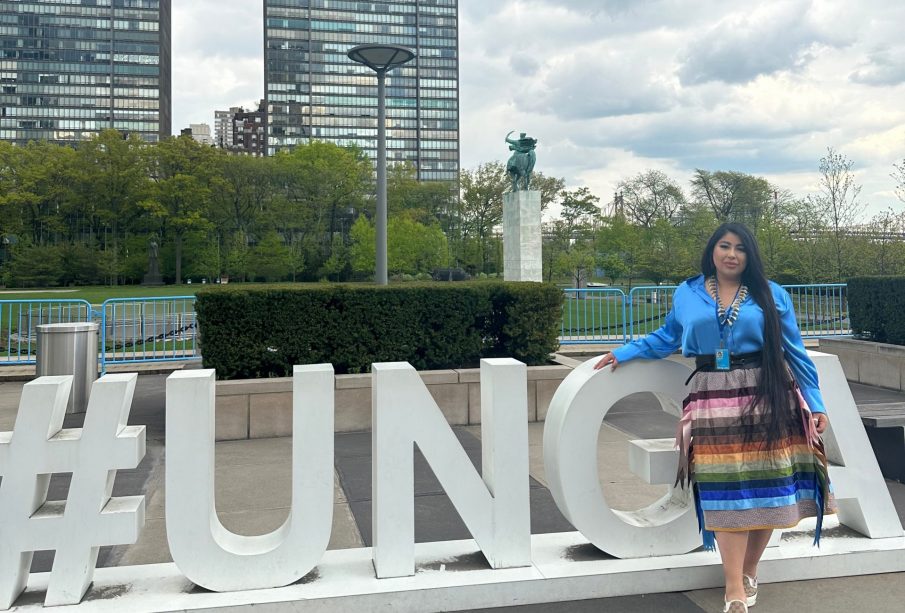
O’Watch is all over the place right now, taking international trips to speak on behalf of Canadian youth.
She is also the founder of Timpsina society, an Indigenous youth-led initiative that blends cultural knowledge with modern advocacy.
One issue that’s important to her is mercury poisoning in Saskatchewan.
You can work on something for years, and a change in government can erase it overnight. —Heather O’Watch
“[It] directly affects Indigenous communities — especially through fishing and traditional food systems,” she says.
O’Watch notes there’s a significant awareness gap of mercury risks in communities. For example, many Indigenous patients still have older mercury-based dental fillings.
There is a critical need for education regarding local environmental hazards, says O’Watch.
O’Watch’s approach to advocacy is spiritual and grounded.
“Being involved with ceremonies and culture,” she explains, had a massive impact on how she navigated her role as an Indigenous advocate.
“Advocacy is something I’ve been part of for a long time, both as a volunteer and professionally,” says O’Watch.
Especially in Indigenous rights, health and environmental justice,” she adds.
‘Sometimes I’m the only Indigenous person in those spaces’
Navigating global politics can be frustrating, says O’Watch.
O’Watch says that decisions made at a global scale can be hard to implement nationally because of funding differences.
These challenges are compounded by the lack of Indigenous voices present in global spaces. “Sometimes I’m the only Indigenous person in those spaces,” she says.
That is why O’Watch is creating spaces for youth — especially racialized voices to amplify those voices.
Advocacy: rock till you drop
The burden of being a changemaker is heavy, says O’Watch.
She talks about the agonizingly slow process of making decisions, only for her voice to sometimes be ignored.
“You can be at the table, and decisions are still being made without you,” O’Watch says.
Heather says that there’s no end to advocacy. It’s something you just keep doing. This can lead to burnout, because you often carry the weight alone.
But O’Watch hopes that she makes a difference and contributes to boosting diversity.
”You might not change everything, but your contribution still matters,” she says.