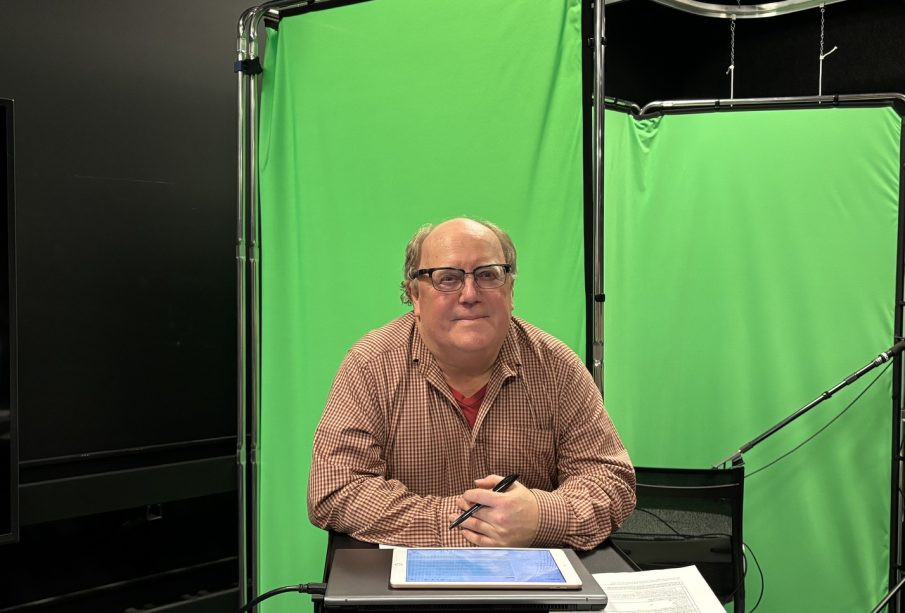
Davis emphasizes the need for journalists during the industry’s growing struggles
Darrell Davis has been a sessional instructor at the Journalism school (J-school) of University of Regina (U of R) for over seven years. He teaches JRN 200, Introduction to Digital News Writing, and JRN 320, Advanced Digital News Writing, alongside his son, Austin Davis, who is the lab instructor for both classes.
A veteran of the journalism industry
Landing his first job in 1981, Davis has been in the journalism industry for more than four decades. Since 2013, he has been a co-host of the sports radio show The Green Zone on CJME Regina. He also has been a co-host, an analyst, pre-game and post-games host for Saskatchewan Roughriders, and guest on a number of podcasts and television shows.
“I have been on television an awful lot as a guest. I guess because of the number of years I’ve been involved as a sports writer in Regina, I’ve become somewhat of a historian or an expert, apparently,” said Davis
Having worked in various journalistic disciplines, Davis believes that writing for print comes naturally to him. He believes that writing is the “best way to communicate”. His experience in news writing helps him teach students on how to become good communicators and helps him understand their struggles as new writers and journalists.
Teaching style
Davis designs the syllabus for his classes in a way that would make students believe they are working as actual journalists. Both his classes consist of multiple newsroom assignments where students spend the class and lab working on news stories of their choice.
A field trip to any small town near Regina is an important part of JRN 200. Before the field trip, students are expected to research the town and find news stories about it. During the trip, students spend the day interviewing different subjects, get photographs for their articles, and get the feel of what is like being a real journalist. Later a magazine is printed with news stories of all the students which helps them build their portfolios which can be useful in the future.
For JRN 320, students work on a group assignment which helps students build collaborative skills called the “major project”.
For both his courses, Davis emphasizes the importance of practicing hands-on writing. He mentioned, “There’s no better way to learn how to write than to do it yourself.”
Students in his class, especially in the introduction course, might get overwhelmed by his grading style as he likes to point out the tiniest details that can be improved.
He says that with each paper he receives, he ends up circling the mistakes and reaching out to the students with corrections. He believes that this is the most effective way of teaching provided the students are aware that he is not trying to be negative and is instead offering support and pushing his students to do their best.
He notes, “I could tell everybody how to write, I could show them how to write, but there’s no better way to learn how to [write] than to do it yourself.”
He also notes the importance of guest speakers in his lectures. His years of experience in the industry has helped him make a number of connections and that is useful in bringing in guest lecturers.
Davis mentioned, “I bring them in and rely on their knowledge, [….] I think that they could do a much better job of explaining the specifics than I could.”
It’s great finding out and seeing where so many of my former students have ended up with their careers in communications or in the media, and that’s probably one of the many moments that stand out for me.” -Darrell Davis
More than a teacher
Davis never thinks of himself as only a teacher. He says that bidirectional learning occurs in his classroom. He says that he learns something new from his students every semester. He believes that the best way to be a teacher is to make sure that he is learning what is going on in the contemporary world from his students’ perspectives while he teaches them what he has learnt from his experience.
He remarks that whenever he attends press conferences and similar events, many reporters turn out to be students that he has taught. “It’s great finding out and seeing where so many of my former students have ended up with their careers in communications or in the media, and that’s probably one of the many moments that stand out for me.”
Davis expressed his sadness when they pulled the plug on J-school for a year. But when it was back on track, he had no hesitation on deciding whether he should go back to teaching at the J-school. He wanted to contribute in any form he could.
“I had no hesitation. I applied. They didn’t even have to ask me if I wanted to apply. I wanted to be on board to help.”
With the restart and reshuffling of J-school, they have lost the interview class that is no longer implemented in the school curriculum. Due to this loss, Davis finds himself backtracking to make sure that in classes he spends more time talking about the process and how interviews are to be conducted.
In addition to that, he highlights that this is an important time to offer journalism degrees at the university as there is a lack of journalists and for the university to realize that it is important to have a journalism school at the U of R.
Piece of advice
Davis offered guidance to students who are going to take his classes. He advises that students shouldn’t be afraid to speak out in his classes. He urges them to not be shy. They should jump in as the class is full of discussions. Everyone in the class is equal and all opinions are welcome, and if there is something that is unclear, reach out to him to ask about it.
He adds that although there are not many mainstream jobs as there used to be in the industry, there are many journalism jobs and opportunities to come by.
Davis finally emphasized that pursuing a journalism degree is important. “I’ve said this hundreds of times and you’ll hear it from a lot of people. There’s never been a more important time to be a journalist than right now.”