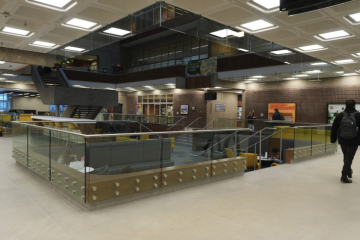
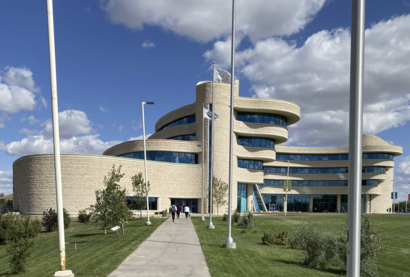
Graduates Hannah Scott and Tyrone Perreault compares FNUniv’s journalism program to U of R’s J-school
In fall 2025, a group of students at the First Nations University of Canada (FNUniv) were the first batch to graduate from the newly created journalism degree through Indigenous Communication Arts program (INCA).
INCA offers a variety of degrees, certificates, and diplomas. The bachelor of arts in Indigenous journalism and communication arts is a four-year undergraduate program, similar to the bachelor of arts in journalism, news media, and communication program at the University of Regina (U of R), and is one of the degrees offered through INCA.
Saviour during J-school’s hiatus
In December 2022, J-school closed admissions for academic year 2023-2024 due to dwindling enrolment numbers and limited funds and staff. Students who were already enrolled in the program said they were left to fend for themselves.
“I planned to do a certificate or diploma with them before the journalism school paused its admissions [which left me] scrambling,” said Hannah Scott, one of the graduates from INCA’s journalism program who now for CBC Saskatchewan.
Like Scott, many students were informed that the program was to be paused indefinitely because they wanted to “revamp and modernize the program.”
With a lack of direction, some students pursued other alternatives. Scott, however, found a pathway to continue doing what she aspired to do through INCA’s journalism program at the FNUniv.
“INCA helped me get back on my feet, and once I knew a full bachelor of arts was coming from them, I made the decision to switch over to [FNUniv],” said Scott.
The INCA program proved to be the right decision for Scott who said she gained many valuable opportunities as a result.
“I met some incredible people in the school, classmates, professors, and guests. I [got the chance] to meet industry experts and have gotten to learn directly from them and their experiences,” Scott said.
INCA helped me get back on my feet, and once I knew a full bachelor of arts was coming from them, I made the decision to switch over to [FNUniv].” – Hannah Scott.
What does INCA’s offer?
The INCA program offers a variety of classes ranging from investigative journalism to learning the ethical policies within the journalism industry. In addition, it also offers a summer institute program which I took in summer 2025. The summer institute in particular is an intensive six-seven week course that offers hands-on learning for students. Over the course you work through all the mediums of media and craft stories for radio, television, social media etc. The course provides students with an opportunity they may have otherwise missed..
Tyrone Perreault, who recently graduated from the INCA program mentioned his experience was incredible and that as a student he felt he was provided with numerous opportunities to gain real world experience.
“Having the chance to learn from individuals who are still active journalists provided us with the unique opportunity to gain relevant advice that we can apply to our careers today,” he said.
As a part of the program both Scott and Perreault had the opportunity to travel to places such as the United States and South Korea respectively.
J-school vs. INCA
Comparing the INCA programs to that of U of R’s J-school, the two are different in many ways.
The main difference between the two journalism schools is in their core fundamentals. According to Perreault INCA is centered around inclusion of Indigenous knowledge and perspectives.
“INCA develops journalists that carry a unique set of ethics that allow them to connect to their audiences in a special way.”
At U of R’s J-school, classes like broadcast journalism and writing for digital media are taught by sessional instructors who are also working journalists similar to the INCA program. These classes do have a significant amount of syllabus that is focused on practical and hands-on work. The paid internship at the end of the degree is still the most appealing aspect of the program.
However, the addition of communications to the program after J-school’s comeback has led to more of a theory-based learning environment devoid of many opportunities to engage in hands-on learning, particularly with the classes on communications. Whereas over at the FNUniv, there is more of an emphasis on showcasing professional development.
The journalism school, given its closure, might have lost a lot of what made it one of a kind. Its reputation of being “one of the best in the country” might be on the line because it no longer offers many of the courses that it used to. Courses such as photojournalism, magazine writing, and interview skills are no longer offered as individualized courses, but rather as part of other classes.
The way I see it, J-school has produced some of the country’s best journalists like Nelson Bird and Creeson Agecoutay. However, J-school’s own struggles and the overall struggles within the journalism industry like the consistent shrinking of the discipline have been on display for the world to see.
The INCA program provided certainty to those like Scott who wanted to pursue a career in journalism and communications in a time where there was uncertainty around the J-school’s comeback. Its hiatus gave INCA the opportunity to show students that there is another option that might be just as good or even better than the J-school.