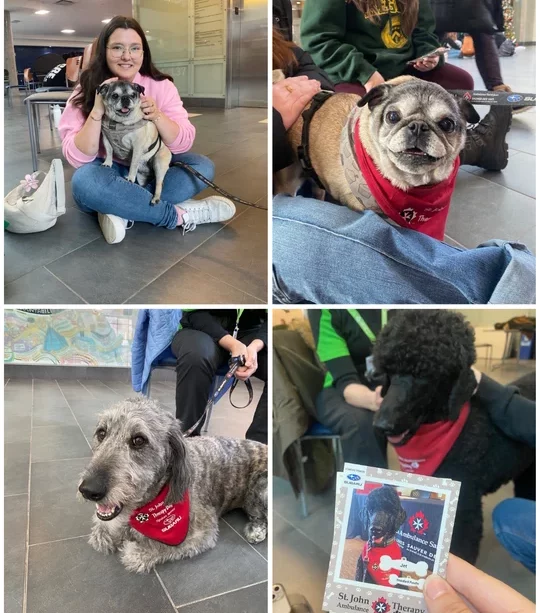
Destress monthly with St John’s Therapy Dog program at UofR
From a distance, you can already see people gathering in small circles, waiting excitedly for their turn to cuddle with the dogs. The atmosphere immediately feels a little softer, a little lighter.
Once a month, several volunteers from St. John Ambulance’s Therapy Dog Program bring their four-legged companions to the Research & Innovation Centre (RIC) at the University of Regina (UofR). Across Canada, St. John Ambulance offers daily programmes that bring support, comfort, and joy to people who need it, in hospitals, seniors’ residences, community centres, libraries, and on university campuses like ours.
More than just pets
Therapy dogs are specially trained pet dogs that support people’s mental well-being. Additionally, the dogs must pass a special exam in which various everyday situations are tested, such as crowds, noise, or unexpected contact. This ensures that they remain calm, friendly, and reliable. They are neither like regular pets nor like service dogs. While service dogs perform specific tasks for one designated person, therapy dogs are trained to provide both emotional and physical comfort. They bring closeness, calm people down, and even encourage social interaction between individuals who might otherwise never speak to each other.
This programme is open to everyone: students, staff, faculty, and other members of the UofR community. Anyone can stop by, cuddle with the dogs, pet them, relax, and enjoy their company. You can also talk to the volunteers, who are always happy to share more about their work and about the dogs’ personalities.
One of the best parts of the programme is the variety of dogs. There are big poodles, such as Lucy and Jet, who are the definition of calmness, quietly lying on the floor and taking all the gentle pats they can get. And then there is the tiny pug Coco, who instantly brings a smile to everyone’s face with her cheerful energy. Each dog has its own sweet personality, and each one contributes to the atmosphere in its own way. Many students don’t want them to go when the session ends.
Therapy dogs create a gentle ‘counterbalance’ to this pressure. They offer a moment to slow down, breathe, refocus, and gain emotional distance from the stress of academic life.” -Magdalena Gaass
A break in the middle of the rush
Many people, especially university students, struggle with an overwhelming workload, high expectations, stress, anxiety, and loneliness. Campus life can be intense and exhausting. Sometimes even a short break feels impossible. Therapy dogs create a gentle ‘counterbalance’ to this pressure. They offer a moment to slow down, breathe, refocus, and gain emotional distance from the stress of academic life.
I personally look forward to these visits every month, especially seeing Coco. She somehow manages to calm me down within minutes. I’m not the only one who feels this way and many other students say the same. “After just ten minutes, everything feels lighter,” is a statement I hear often, and I completely agree.
Why are therapy dogs so effective?
Studies have shown that animal-assisted therapy significantly improves mental well-being. Spending time with animals can reduce stress and anxiety, lower cortisol levels, and increase overall life satisfaction. At the same time, interacting with a friendly dog stimulates the release of oxytocin, often called the ‘cuddle’ or ‘love’ hormone. The combination of reduced stress hormones and increased oxytocin helps people feel calmer, safer, and more grounded.
The programme is a wonderful opportunity to escape the academic routine for a moment, especially during exam periods like now, when stress levels are high and mental well-being is often neglected. It also strengthens the campus community by bringing people together. Students who have never met before start chatting while petting the same dog. Volunteers share stories about the dogs’ training, personalities, and experiences. The visits create small but memorable moments of connection.
Sometimes all we really need is a friendly wagging tail to make the entire day brighter, easier, and a little more hopeful.